
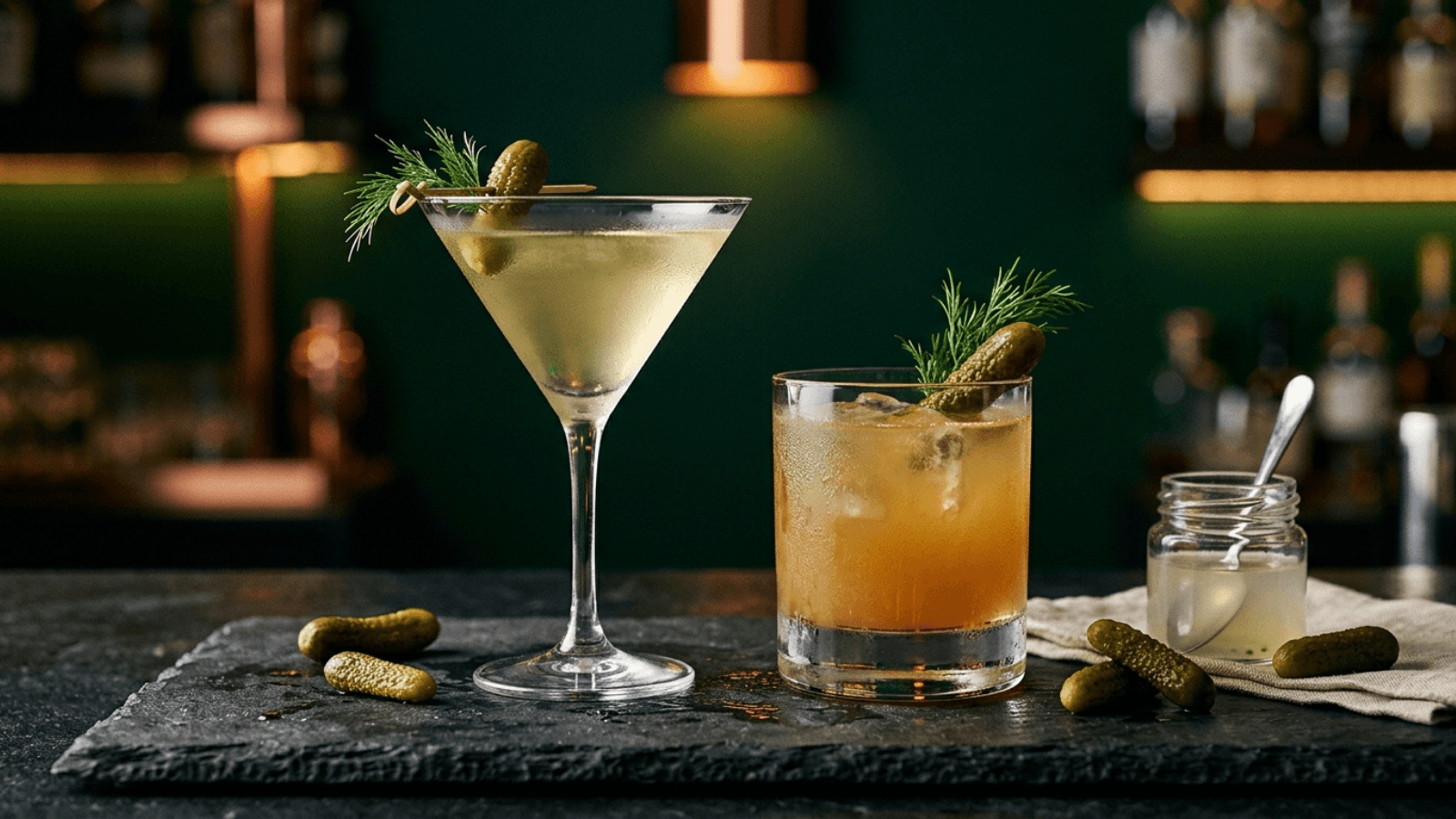
If you've ever stood over the sink and finished off the last few ounces of pickle juice straight from the jar, you're not weird. You're early.
For years, sweet was the only language cocktails spoke. Simple syrup, sour mix, a fruit garnish that was really just there to look pretty. But something's shifted. Bars and home bars alike are leaning into salty, sour, fermented flavors — the stuff that makes your mouth water instead of just puckering up from sugar. Pickle brine is leading that charge, and honestly, it's earned the spot.
If you're skeptical about pouring vinegar-based brine into a glass of good gin, that's fair too. It sounds like a bad idea until you actually try it. Once you understand what the brine is doing to the drink — not just adding "pickle flavor," but actually changing how your tongue and nose experience the spirit — it stops sounding weird and starts sounding smart.
Why Pickle Brine Actually Works in a Cocktail
Here's the short version: your tongue picks up five basic tastes — sweet, sour, salty, bitter, and umami. Most cocktails are built around a tug-of-war between sweet and sour. Brine adds a third player: salt.
Salt is a bouncer. When sodium hits your taste buds, it makes it harder for your bitter receptors to do their job. Bitterness is normally the flavor standing at the door turning away the good stuff — it's an old survival instinct, since bitter used to mean "don't eat this, it might be poison." Dial the bitterness down, and the sweeter, more delicate notes in a spirit — the honey in a good bourbon, the botanicals in gin, the agave in tequila — get a clear path to the stage. That's why a well-balanced brine cocktail can taste smoother and rounder than the same drink without it, even with zero added sugar.
Salt also does something to the aroma. Dissolved sodium changes the surface tension of a liquid, which helps the aromatic compounds — the stuff your nose actually smells — escape the liquid faster. Think of it like popping the lid off a simmering pot. All that scent that was trapped under the surface suddenly hits you before the first sip even touches your lips. That's part of why a good briny cocktail smells more interesting than it has any right to.
Then there's the acid. Pickle brine gets its tang from vinegar, not lime or lemon juice. Vinegar's acidity hangs around on your tongue longer than citrus does, and combined with the salt, it makes your mouth water almost instantly. That extra saliva coats your palate, which softens the burn of high-proof spirits and makes the whole drink feel weightier and smoother going down.
A Few Terms Worth Knowing
Saline solution — Just salt dissolved in water, at a strength most bartenders can measure by feel. A few drops does the bitterness-blocking trick without making a drink taste "salty" on its own.
Mouthfeel — How a drink feels in your mouth, not how it tastes. Weight, texture, whether it feels thin like water or rich like cream.
Volatilization — The fancy word for how aroma compounds jump from liquid to air. It's why a drink can smell incredible before you've had a sip.
Fortified wine — Wine with extra spirit added to boost the alcohol content, usually infused with herbs and botanicals. Vermouth is the one you'll run into most.
Dry shake — Shaking a cocktail without ice first, usually to build foam from egg white or aquafaba. We're skipping that step in this guide, but it's good to know if you see it elsewhere.
The Recipe Catalog: Five Ways to Drink Savory
These five cover the major spirits, so whatever's already on your bar cart, there's a way in.
Gin: The Freezer-Door Dill Pickletini
This one's for hosts who like to prep once and pour for days. You build the whole cocktail right in the gin bottle, stash it in the freezer, and pour ice-cold martinis straight out of it whenever you want one. No shaker, no stirring, no mess.
Target vibe: Crisp, herbal, and cold enough to make your teeth ache a little in the best way.
The trick to a freezer-door batch is dilution. Normally, shaking or stirring a martini over ice adds water that softens the alcohol burn and lets the botanicals bloom. Here, you're building that water into the bottle up front so every pour is already perfectly balanced — and because the alcohol percentage stays high enough, the bottle won't freeze solid sitting in your freezer door.
Ingredients (makes about 8 servings from one 750ml bottle):
- 17 oz London Dry gin (pour off about 8.5 oz from a fresh 750ml bottle first)
- 3.4 oz dry vermouth
- 3.4 oz unpasteurized dill pickle brine (refrigerated brine, not shelf-stable — more on why below)
- 1.7 oz filtered water
Garnish: baby gherkins or cornichons on a cocktail pick
How to make it:
- Pour about 8.5 oz of gin out of a fresh 750ml bottle into a separate container and set it aside for another use.
- Funnel the vermouth, pickle brine, and filtered water into the bottle.
- Cap it tight and shake for about 10 seconds to combine everything.
- Set the bottle in your freezer door and let it chill for at least 8 hours, ideally overnight.
- Chill your coupe or Nick & Nora glasses for 20 minutes before serving.
- Pour straight from the freezer into the frosted glass and garnish with a gherkin.
If a single shaken martini is more your speed than a whole batched bottle, the Pickle MartiniView full recipe → already lives on the site. It is built on vodka rather than gin and shaken to order, swapping the olive brine of a dirty martini for pickle brine — a good side-by-side if you want to taste what the freezer-built batch is actually doing differently.
Tequila: The Tajín-Rimmed Picklerita
This is the loud one. Spicy, salty, a little sweet, and built for a backyard table full of people who are going to ask for the recipe before they finish their first glass.
Target vibe: High-energy, spicy, savory, built for a crowd.
Before you build the drink, you'll muddle a couple slices of jalapeño with the agave nectar. Muddling just means gently pressing fresh ingredients in the bottom of the shaker to release their oils and juice — you're not trying to pulverize the pepper, just wake it up.
Ingredients (single serving):
- 2 oz blanco tequila
- 1 oz fresh lime juice
- 0.5 oz orange liqueur
- 0.75 oz spicy dill pickle brine
- 0.5 oz agave nectar
- 2 slices fresh jalapeño
Rim: 1 tablespoon Tajín seasoning mixed with 1 tablespoon flaky sea salt Garnish: lime wheel and a pickle spear
How to make it:
- Rub a lime wedge around the rim of a rocks glass, then dip the wet rim in the Tajín-salt mix at an angle so it only coats the outside. Fill the glass with ice.
- Muddle the jalapeño slices and agave nectar gently in the bottom of a shaker, 3 to 4 presses.
- Add the tequila, lime juice, orange liqueur, and pickle brine, then fill with ice.
- Shake hard for about 15 seconds, until the shaker frosts over.
- Double-strain into the prepared glass over fresh ice. Garnish with the lime wheel and pickle spear.
Vodka: The Effervescent Pickle Juice Spritz
The lightest drink on this list, and the one to reach for at brunch or on a hot afternoon when a full-proof cocktail feels like too much.
Target vibe: Bubbly, herbal, refreshing, low commitment.
Effervescence — the bubbles you get from carbon dioxide escaping a liquid — does a lot of heavy lifting here. As those bubbles rise and pop, they carry aroma up with them, so the drink smells brighter and more alive than a still cocktail with the same ingredients.
Ingredients (single serving):
- 1 oz vodka
- 0.5 oz dry white vermouth
- 1.5 oz dill pickle brine
- 3 oz dry Prosecco, chilled
- 1 oz club soda, ice cold
Garnish: shaved pickle ribbon and a fresh dill sprig
How to make it:
- Chill a wine or balloon glass in the freezer for about 10 minutes.
- Drop in one large ice cube. Add the vodka, vermouth, and pickle brine, and stir gently for 5 seconds.
- Slowly pour in the Prosecco and club soda, aiming away from the ice cube so you don't knock the bubbles out.
- Give it one gentle lift with a bar spoon from the bottom of the glass to combine.
- Use a vegetable peeler to shave a thin ribbon of pickle for garnish, thread it onto a pick, and slap the dill sprig against your hand before dropping it in — that little smack releases more of its aroma.
Whiskey: The Elevated Pickleback Sour
Every savory cocktail conversation eventually circles back to the Pickleback — the shot of whiskey chased with pickle brine that bartender Reggie Cunningham started serving at the Bushwick Country Club in Brooklyn back in March 2006. The story goes that a customer talked him into trying it, a pickle company happened to be storing brine in the bar's basement at the time, and the combination took off from there into one of the most recognized bar orders in the country.
That shot is the shortcut version. This is the long version — a proper lemon-forward whiskey sour with pickle brine built in, no egg white required. Skipping the egg white means one less step and no risk of a flat foam if your shake wasn't vigorous enough, and the drink is every bit as smooth without it.
Target vibe: Rich, tart, and briny, built to sip slowly.
Ingredients (single serving):
- 2 oz bourbon or rye whiskey
- 1 oz fresh lemon juice
- 0.75 oz rich simple syrup (2 parts sugar to 1 part water)
- 0.75 oz dill pickle brine (a garlic-forward brine works especially well here)
Rim: Old Bay seasoning mixed with flaky sea salt, or plain flaky salt if you want it simpler Garnish: a dash of Angostura bitters and a fresh dill sprig
How to make it:
- Rim a chilled coupe with the Old Bay-salt mix, coating only the outside edge.
- Add the whiskey, lemon juice, simple syrup, and pickle brine to a shaker with ice.
- Shake hard for 12 to 15 seconds, until the shaker is ice cold to the touch.
- Double-strain into the prepared coupe, leaving the ice behind in the shaker.
- Add a dash of bitters on top and finish with the dill sprig.
If you want the classic version this recipe is built from, the Pickleback ShotView full recipe → is on the site in its original bar-order form — whiskey, brine, no glass required.
Low & No-Alcohol: The Southern "Witch Doctor" Soda Hack
This one didn't come out of a cocktail lab. It's a regional soda fountain tradition out of North Carolina — a mix of just about every soda in the machine, finished with pickle brine and pickle slices. Don Frye put the first one together in the mid-1950s at his family roller rink and swimming lake on Poplar Tent Road in Concord, and his wife Nell gave it the name. It's been a local favorite around Concord and Kannapolis for decades, most associated today with the region's What-A-Burger drive-ins, and it's the kind of drink people either grew up on or think you're joking about.
Target vibe: Sweet, tart, weirdly nostalgic, and it works.
The trick is that a soda blend this complex can actually handle brine without getting thrown off balance. Cheerwine, a burgundy-red cherry soda bottled in Salisbury, North Carolina since 1917, is doing a lot of the work here. It is what gives the glass its muddy-red color and keeps the cherry note from vanishing under the vinegar. Dr Pepper in particular has leaned on its "23 flavors" marketing claim since the 1920s — the company has never confirmed exactly what all 23 are, but the drink's spiced, layered flavor is well documented, and it's sturdy enough to stand up to something as sharp as pickle juice without getting lost.
Ingredients (single serving):
- 1.5 oz Dr Pepper, ice cold
- 1.5 oz cola
- 1.5 oz lemon-lime soda
- 1.5 oz Cheerwine
- 1.5 oz Sun Drop
- 1.5 oz dill pickle brine, chilled
Garnish: 4 round pickle slices and a lemon wedge
Cheerwine and Sun Drop are Carolina sodas and can be hard to track down elsewhere. Outside the region, any wild-cherry soda and any bright citrus soda will get you close. The cherry is the one to prioritize, because it carries the muddy-red color and keeps the brine from running away with the glass.
How to make it:
- Fill a tall glass to the brim with crushed or pebble ice.
- Pour in the Dr Pepper, cola, lemon-lime soda, Cheerwine, and Sun Drop, leaving a couple inches of room at the top.
- Float the pickle brine slowly over the top.
- Stir gently, 3 to 4 passes with a long spoon, to bring the sweet and savory together.
- Drop in the pickle slices so they float through the glass, squeeze the lemon wedge over the top, and serve with a wide straw.
Host Hacks: Getting the Details Right
Savory cocktails don't forgive sloppy prep the way a sweet drink might. Get the brine or the temperature wrong and the whole thing falls apart fast. A couple of things worth knowing before you build a menu around these.
Not All Brine Is Created Equal
The single biggest mistake people make is grabbing whatever pickle jar has been sitting in the back of the fridge for months. There's actually a real difference between shelf-stable and refrigerated brine, and it matters more than you'd think.
Shelf-stable pickles — the ones that sit at room temperature on a grocery shelf — go through a hot pasteurization process so they can last up to two years unrefrigerated. That heat cooks the cucumbers and the brine right along with them, which flattens the aromatics, dulls the color, and leaves you with a brine that tastes flat and overly salty in a clean spirit.
Refrigerated pickles never get that heat treatment. They're kept cold the whole way from the farm to the jar, which keeps the brine bright, acidic, and full of the herbs and aromatics that made you want to use it in the first place. If a recipe says "pickle brine" in this guide, it means refrigerated, not shelf-stable.
Within refrigerated brands, the flavor profile shifts too. A more vinegar-forward, dill-heavy brine — the kind that includes grape leaves for a little natural dryness — works beautifully in something clean like a Martini or a Spritz. A garlic-forward, heavier-salt brine holds up better in a bolder build, like the Pickleback Sour or a Bloody Mary. Taste a spoonful before you commit a whole bottle of good spirit to it — you'll be able to tell the difference immediately.
If you want to go a step further, you can skip the jar entirely. Craft Cocktail Pickle Brine walks through building your own bar-quality brine from scratch, quick-pickling real cucumber spears in a spiced vinegar solution so the brine itself picks up more depth than anything poured straight from a store-bought jar.
The Savory Chill Rule
Warm sweet drinks aren't a disaster — warmth can actually make sugar taste sweeter. Savory drinks don't get that same grace. As a briny cocktail warms up, the alcohol starts tasting harsher and the salt and vinegar turn heavy and almost metallic on the tongue.
The fix is simple: keep everything colder than you think you need to.
- Freeze your glassware for at least 20 minutes before pouring.
- Skip small, wet, or crushed ice in a shaker for anything spirit-forward — it melts too fast and waters down the tight balance between the salt and the acid before you even get to drink it.
Why Clear Ice Makes Better Cocktails
Speaking of ice — the cubes you use for serving matter just as much as the ones you shake with. Standard freezer ice freezes from the outside in, which traps air bubbles and minerals in the center. That's what makes it cloudy, and cloudy ice melts fast, which means rapid, uncontrolled dilution that can wreck a carefully balanced briny drink before you're halfway through it.
If you want to go deeper on this, Why Clear Ice Makes Better Cocktails (And How to Make It at Home) walks through the directional freezing method that gets you slow-melting, crystal-clear cubes at home. It's a little bit of extra effort for a drink that stays balanced from the first sip to the last.
Find Your Next Pour
Not sure which of these to start with, or want something totally different next time? The Drink Roulette tool will pick your next adventurous pour for you if you're feeling indecisive. And if you already know what's sitting on your bar cart and want a recipe built around it, the Spirit Finder tool will point you toward something that actually uses what you've got.
Savory cocktails aren't a phase. They're just what happens when people finally get tired of drinking dessert.