
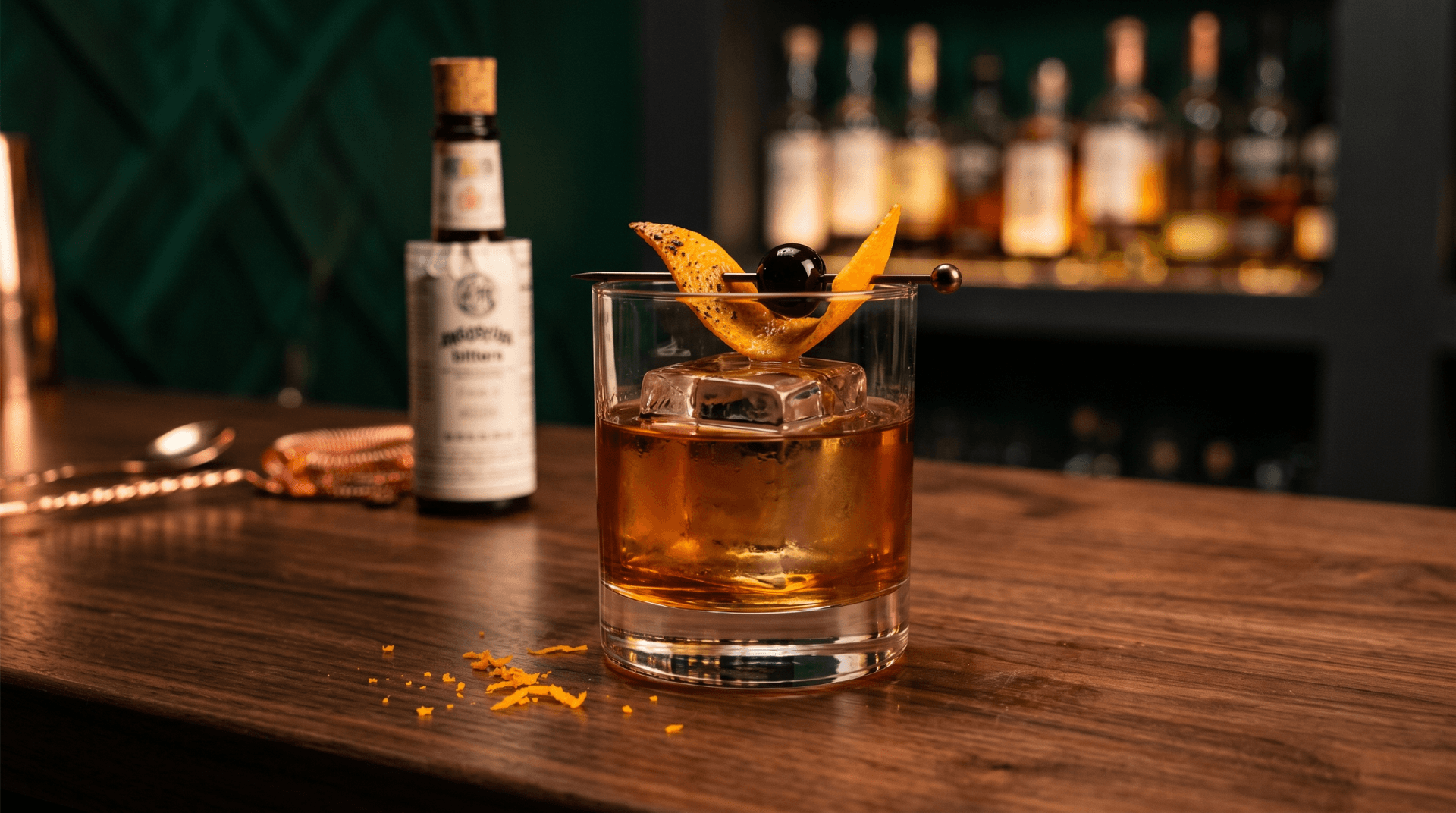
Here's a fun bar fact to pull out next time somebody calls the Old Fashioned "just whiskey and sugar." That somebody is basically describing the very first cocktail ever written down. Spirit, sugar, water, bitters. That's it. That's the whole original definition of the word "cocktail," and the Old Fashioned is the drink that still wears it.
Most cocktails got fancier over the years. This one mostly stayed put. And that's exactly why it's worth knowing.
The First Cocktail Was Pretty Much an Old Fashioned
Back on May 13, 1806, a small newspaper in Hudson, New York called The Balance and Columbian Repository ran a reader's question. The week before, the paper had used this weird new word — "cock-tail" — and a confused subscriber wrote in asking what the heck it meant.
The editor answered plainly. A cocktail, he said, is a stimulating liquor made of spirits of any kind, sugar, water, and bitters. He even added that folks back then called it a "bittered sling."
Read that recipe again. Spirit, sugar, water, bitters. Swap in whiskey and that is an Old Fashioned, full stop. The drink we sip today is the oldest idea in the whole cocktail book.
The bitters part came over from England. A London apothecary named Richard Stoughton mixed up the first commercial aromatic bitters around 1690. Think of bitters back then like the cough syrup of the day — people took them to settle the stomach. By the 1700s those bitters had crossed the ocean, and early Americans started splashing them into local whiskey. They drank it straight, no ice, sometimes first thing in the morning. Different times.
Where the Name Actually Came From
So if the drink existed in 1806, why didn't anybody call it an "Old Fashioned" until the 1880s? Because bartenders got bored.
By the middle of the 1800s, the golden age of bartending kicked in. New liqueurs showed up. Guys behind the bar started "improving" the basic whiskey cocktail with dashes of absinthe, orange curaçao, maraschino — all kinds of extra stuff. Some of it was great. Some of it was a Christmas tree in a glass.
A chunk of drinkers wanted none of it. They'd bellies up and ask for a whiskey cocktail made the old-fashioned way. Just the bones. No fruit salad, no fancy cordials. And the name stuck.
You can actually watch it happen in the old recipe books. Jerry Thomas, the godfather of American bartending, published his guide in 1862 with a recipe called the Old Fashioned Holland Gin Cocktail. Funny thing — it was made with gin, not whiskey. By 1895, George Kappeler's book Modern American Drinks spelled out the whiskey version we'd recognize, right down to leaving a little spoon in the glass so you could stir it yourself.
The Myth About a Kentucky Club
Here's the origin story you've probably heard, and it's a good one. The trouble is it's mostly BS.
The legend goes that a bartender at the Pendennis Club in Louisville, Kentucky invented the Old Fashioned to honor a member named Colonel James E. Pepper, a big-shot bourbon distiller. Pepper supposedly carried the recipe to the Waldorf-Astoria in New York and made it famous.
One problem. The Pendennis Club didn't open until 1881. The Chicago Daily Tribune was already writing about "old fashioned cocktails" in February of 1880 — a full year earlier. Cocktail historians like David Wondrich, Robert Simonson, and Simon Difford all looked at the timeline and called it busted.
Now, Colonel Pepper was a real guy, and a heck of a salesman. He rode around in a private rail car painted with his whiskey label and rubbed elbows with the Rockefellers and Roosevelts of the world. He didn't invent the Old Fashioned. He sold the daylights out of it. The fairy tale itself didn't take off until the 1930s, when a Waldorf-Astoria writer put it in print. Good branding has a long shelf life.
The truth is less romantic but kind of better: nobody "invented" the Old Fashioned. It's just the original cocktail that refused to go out of style.
Sugar Cube or Simple Syrup?
Walk into ten bars and you'll see the Old Fashioned made ten ways. The biggest fight is over the sweetener, and there's actual science behind it.
The old-school move is a sugar cube. You drop it in the glass, soak it with bitters and a splash of water, and muddle it into a paste. It looks great and feels like history.
The catch is that sugar doesn't want to dissolve in cold booze. Once you add chilled whiskey and ice, a lot of that sugar just gives up and settles at the bottom. Your first sip is bone dry and your last sip is syrup. It's like not stirring your iced coffee — all the sweet stuff hides at the bottom waiting to ambush you.
That's why a lot of bartenders switched to simple syrup, which is just sugar already melted into water. It blends in clean and tastes the same from top to bottom. Less romance, more consistency. Both make a good drink. Pick your fighter.
Bitters Are the Whole Point
People skip the bitters because the bottle is tiny and you only use a couple dashes. Big mistake. Bitters are the thing that makes a cocktail a cocktail in the first place — remember, they're right there in that 1806 definition.
Think of bitters like the spice rack in your kitchen. A couple dashes won't make the drink taste "bitter," same way a pinch of salt doesn't make your eggs taste like salt. What it does is wake everything up and tie the sweet sugar to the woody, caramel notes in the whiskey. Pull the bitters out and the drink tastes flat and one-note, and you won't be able to say why.
Classic aromatic bitters, like Angostura, lean on baking-spice flavors that play nice with bourbon and rye. Orange bitters brighten the whole thing up. Once you start playing around, you'll get why bartenders treat that little shelf of bottles like seasoning.
How to Make a Proper Old Fashioned
If you want the gold standard, the recipe from the International Bartenders Association is about as official as it gets. It's dead simple.
You take about 1.5 ounces of bourbon or rye, one sugar cube, a few dashes of Angostura bitters, and a small splash of plain water. Drop the cube in the glass, soak it with the bitters and water, and muddle until it dissolves. Fill the glass with ice, pour in the whiskey, and stir gently. Garnish with an orange slice or a twist of peel and a cocktail cherry.
One tip that actually matters: use one big ice cube instead of a handful of little ones. A big cube has less surface touching the drink, so it melts slow and keeps your whiskey from turning watery before you finish it. It's the same reason a big block of ice in a cooler lasts longer than a bag of cubes.
If you like a little more body, a rich whiskey like a higher-proof bourbon holds up well. And if you only have simple syrup instead of a cube, use about a quarter ounce. Nobody's checking your work.
The Wisconsin Thing
Order an Old Fashioned in Wisconsin and you're getting a different animal, and they're proud of it. Out there it's usually made with brandy instead of whiskey, with an orange slice and a cherry muddled right into the glass. Then they ask if you want it "sweet" (topped with a lemon-lime soda), "sour" (topped with a tart soda), or "press" (a mix).
There's a popular story that Wisconsinites fell for brandy at the 1893 World's Fair in Chicago and never looked back. It's a charming tale, but the brandy habit really took hold later, around the years after World War II. Either way, the brandy Brandy Old FashionedView full recipe → is a genuine regional classic, not a mistake. If you grew up on it, the whiskey version probably tastes wrong to you, and that's fair.
That muddled-fruit style isn't just a Wisconsin thing, either. It crept in nationwide during Prohibition, when piling fruit into the glass helped cover up the taste of rough bootleg whiskey. Once people got used to it, it never fully left.
Riffs Worth Knowing
The beauty of the Old Fashioned is that the formula — good spirit, a little sweet, some bitters, big ice — works with almost anything. Swap the base and you've got a whole new drink.
A few that earned their spot:
The Oaxaca Old FashionedView full recipe → is the famous one. Bartender Phil Ward built it at New York's Death & Co bar back in 2007 using tequila with a little mezcal for smoke. It kicked off the whole agave-cocktail craze. If you want it smokier, the Mezcal Old FashionedView full recipe → leans all the way in.
The Bentons Old FashionedView full recipe → is the wild one. That same year, bartender Don Lee at a New York bar called PDT washed bourbon with real bacon fat and sweetened it with maple syrup. Yes, bacon. It tastes like breakfast and it's a modern classic. If that sounds like too much of a project, the Maple Bacon Old FashionedView full recipe → gets you to the same neighborhood with less fuss.
Beyond those, you've got the Rum Old FashionedView full recipe → with aged rum and a dark, molasses-y syrup, the Tequila Old FashionedView full recipe → sweetened with agave nectar, the Irish Old FashionedView full recipe → for something smoother, the cozy Maple Old FashionedView full recipe →, and the showy Smoked Old FashionedView full recipe → if you've got a smoking gun and something to prove.
While you're in the neighborhood, the ManhattanView full recipe → and the SazeracView full recipe → are close cousins — same old-school whiskey-and-bitters family tree, just dressed a little different. And if you want to go all the way back to bartending's early days, the Mint JulepView full recipe → was in Jerry Thomas's book right alongside that gin Old Fashioned.
The Bottom Line
The Old Fashioned has been around so long your great-grandparents probably drank something close to it. It survived fancy liqueurs, Prohibition, the blender era, and a hundred years of trends — and it's still four simple ingredients in a heavy glass.
Some things get better with age. Some things were just right to begin with. Pour one and decide for yourself.